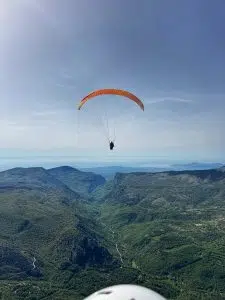
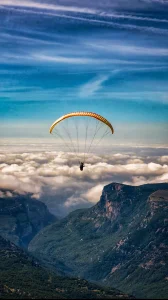
Ozone's Ultralite series has been a benchmark in touring gliders for almost twenty years. With the fifth version, the New Zealand manufacturer has gone one step further: the Ultralite 5 is 0.8 points thinner and 7 km/h faster, while being 100g lighter than its predecessor. At 1.76 kg in size 17 m², it is the lightest certified dual-surface wing per square metre of flat surface.
But beyond the figures, what difference does it make in practice in the air? That's the question every rando, trail or mountain pilot asks before investing. With the range extended from 13 m² to 25 m², a new SharkNose specifically developed to improve inflation and take-off sequence, and a modified twist that has considerably reduced drag, this new version promises more intuitive and direct piloting without compromising safety.
At Ailéments, our qualified instructors fly every day from Gréolières, in the heart of the Alpes-Maritimes. This guide offers you our full analysis of the Ultralite 5: real-world performance, help with sizing, behaviour in alpine conditions, positioning in relation to the competition, price and availability. The aim is to give you all the information you need to decide whether this wing is right for you and your size.
The advertised 0.8 point gain in glide ratio is not just a marketing figure. In concrete terms, at each transition between two thermals, the Ultralite 5 gives you more distance. On a glide of 1,000 metres, that's several tens of metres more altitude than with version 4. For a rando-flight or bivouac pilot, this difference means more opportunities to hang up a thermal and extend your flights.
The 7 km/h increase in accelerated speed is the biggest improvement ever made to an Ozone wing in this category. The benefits are twofold: better penetration of headwinds and faster transitions between lift. All this without compromising glide - the wing offers the same sink rate as before, but 7 km/h faster. It's a real performance boost that changes the game in alpine conditions.
In terms of weight, the 100g reduction may seem modest. But on an ultra-light flight kit where every gram counts, dropping below 1.76 kg in 17 m² confirms the Ultralite 5's status as the lightest certified dual-surface wing on the market. And this extra lightness is felt as soon as you take off, with your rucksack on your back.
At the heart of this new version is the SharkNose, specifically developed for the Ultralite, which changes the launch sequence. The redesigned leading edge profile significantly improves inflation: the canopy rises more cleanly, stabilises faster overhead and requires less correction. In the mountains, where take-offs are often on steep slopes with little room to manoeuvre, this is an essential quality. The Ultralite 5 takes off in the mountains in fewer steps than any light wing tested by Ozone to date.
The new cut of the fabric panels and a modified twist have significantly reduced drag, improving the wing's true performance without compromising safety. The new canopy curvature makes the Ultralite 5 more compact once airborne, with a more intuitive and direct handling than the V4. The controls are precise and progressive, and the wing responds without dead time. This work on the vault also has an effect on packing volume: the wing compresses better in a compression bag, an advantage for trail flyers who need to optimise every litre of their rucksack. To anticipate the best weather windows before a trail-flying outing, consult our guide Meteoblue and paragliding weather.
The Ultralite 5 range extends from 13 m² to 25 m², with 7 sizes to cover all sizes and all types of practice. Here are the manufacturer's specifications:
| Size | Surface area (m²) | Wing weight | PTV min-max | Main use |
|---|---|---|---|---|
| XXS | 13 | 1.42 kg | Load tested only | Paralpinism, ultra-minimalist |
| XS | 15 | 1.59 kg | Load tested only | Trail-flying, light pilots |
| S | 17 | 1.76 kg | 55-85 kg | Trail-flying, fast hiking-flying |
| SM | 19 | 1.95 kg | 60-95 kg | Multi-purpose hike-and-fly |
| ML | 21 | 2.15 kg | 70-105 kg | Hiking-flying, flying-bivouac |
| L | 23 | 2.35 kg | 80-115 kg | Bivouac flights, mountain comfort flights |
| XL | 25 | 2.55 kg | 90-125 kg | Heavy templates, loaded kit |
The weight can vary by up to 50 grams for the same size, due to natural variations in the weight of the fabric. This is normal for an ultra-light wing and does not affect performance or safety.
Sizes XXS (13 m²) and XS (15 m²) are load-tested only. This means that they have not undergone the classic EN/LTF certification process with a pilot in flight, but have been subjected to structural strength tests. In practice, these sizes are aimed at experienced, light pilots who practice paralpinism or committed trail flying and who are willing to fly a wing that is not approved in the traditional sense. If you're new to mountain flying, you'll want to consider the S sizes (17 m²) and above, which are fully certified.
By default, the Ultralite 5 is delivered with ultra-light, compact dyneema risers. For sizes 17m to 25m, Ozone offers optional standard risers with 12mm webbing and quick links, adding around 180g to the kit. The choice depends on your flying style: light risers are ideal for trail flying and rando flying, where every gram counts. The standard risers are recommended if you use the Ultralite 5 as a versatile wing for soaring, regular thermalling or occasional cross-country flying, where comfort of use takes precedence over weight.
This is probably the most striking improvement in day-to-day flying. The launch sequence of the Ultralite 5 is the shortest ever seen on a light wing in this category. On a steep launch in the mountains, with little space and a sometimes irregular wind, the wing inflates with remarkable fluidity thanks to the new SharkNose. It rises overhead without overspeeding or overshooting, stabilises almost instantly and requires very little correction before launching. When you're taking off in the mountains after an hour's walk, this reliable inflation is not a luxury: it's a safety feature.
Once in the air, the Ultralite 5 doesn't behave like a simple descent wing. It exploits thermals with sufficient efficiency and manoeuvrability to climb efficiently. The handling is intuitive, and the controls respond precisely and progressively. In accelerated transition, stability at full bar is excellent - it's even possible to put your hands between the B's and C's to steer at the back, a sign of a solid and reassuring wing at high speed.
It's comfortable and easy to use, even in sustained thermal conditions. The wing filters out turbulence without excessive parasitic movements, allowing you to remain focused on navigation rather than active piloting. Whether you're soaring along the edge of a ridge or flying through a challenging transition in an Alpine valley, this serenity of flight makes all the difference over time.
If you're looking for your first ultra-light flying kit, the Ultralite 5 is probably the most accessible and enjoyable choice on the market today. Its reassuring inflation behaviour, intuitive piloting and tolerance of a wide range of conditions make it a wing you can quickly trust. Combined with a lightweight harness and a suitable compression bag, it makes up a complete flight kit weighing under 4kg, opening up possibilities for trekking and trail flying that are inaccessible with standard equipment. Pilots who practice paragliding and hiking find in the Ultralite 5 an ideal ally for exploring new routes. Whether you're obsessed with lightness or simply curious about mountain flying, an Ultralite 5 will meet your needs.
The Ultralite 5 is a benchmark in the dual-surface ultralight market. Its range of 7 sizes (13 to 25 m²) is the widest in the segment, satisfying both light pilots in paralpinism mode and heavy pilots with a loaded bivouac kit. No direct competitor offers such a range.
Its weight/performance ratio is currently the best in its category. With the same surface area, the Ultralite 5 weighs less than the Supair Eiko, the Advance Pi 3 or the Niviuk Skin 4, while offering comparable if not superior glide and speed performance. The legacy of 20 years of Ozone development in the ultralight segment - from X-Alps to Everest to record-breaking bivouac flights - translates into a design maturity that more recent competitors have yet to achieve.
SharkNose technology, tried and tested on Ozone performance wings and then adapted specifically for the Ultralite, is a concrete advantage on take-off and in flight. It's an innovation that's more than just a sales argument: you feel it from the very first inflation.
Like all ultra-light wings, the Ultralite 5 uses fabrics and lines designed to minimise weight. The trade-off is a shorter lifespan than that of a standard wing: allow around 300 to 400 flying hours before an paraglider revision You don't need to put in 500 hours or more on a classic glider. If you fly 100 hours a year just cross-country, that's more than enough. If you're looking for a single wing to do it all, including intensive thermalling, a standard fabric model will be more durable.
The price has also risen compared with the first generations of Ultralite. This is a general trend in the lightweight wing market: high-performance materials cost more. The investment is justified by the gain in comfort when climbing and the performance in flight, but it must be weighed against the volume of flying you do.
The Alpes-Maritimes is an exceptional playground for mountain flying and trekking. Between the Mercantour massif and the Mediterranean, the possibilities for hiking with take-off at altitude are numerous and varied. This is exactly the type of terrain where a wing like the Ultralite 5 comes into its own: light to carry in your rucksack during the climb, and powerful once in the air to exploit the alpine conditions.
Gréolières, Ailéments' main site is an ideal starting point for hiking and flying. The Cheiron massif offers accessible walking and flying routes, with high-altitude take-offs and aerological conditions that our instructors know like the back of their hand. From the air, the view stretches from the Mediterranean to the peaks of the Mercantour - a setting that makes you want to extend every flight.
For pilots who want to progress towards autonomous mountain flying, our paragliding courses The Ultralite 5 and Ultralite 5 offer the necessary skills: reading the alpine aerology, choosing launch options, managing thermal conditions in the mountains. With a wing like the Ultralite 5, combined with solid training in the’Ailéments paragliding school, You'll have everything you need to enjoy mountain flying in complete safety.
And for those who want to combine all these sensations, Ailéments is the only structure in the region to offer the paragliding and canyoning combo - a full day between sky and canyon in the Gorges du Loup. Experience the mountains from every angle.
The Alpes-Maritimes is an exceptional playground for mountain flying and trekking. Between the Mercantour massif and the Mediterranean, the possibilities for hiking with take-off at altitude are numerous and varied. This is exactly the type of terrain where a wing like the Ultralite 5 comes into its own: light to carry in your rucksack during the climb, and powerful once in the air to exploit the alpine conditions.
Gréolières, Ailéments' main site is an ideal starting point for hiking and flying. The Cheiron massif offers accessible walking and flying routes, with high-altitude take-offs and aerological conditions that our instructors know like the back of their hand. From the air, the view stretches from the Mediterranean to the peaks of the Mercantour - a setting that makes you want to extend every flight.
For pilots who want to progress towards autonomous mountain flying, our paragliding courses The Ultralite 5 and Ultralite 5 offer the necessary skills: reading the alpine aerology, choosing launch options, managing thermal conditions in the mountains. With a wing like the Ultralite 5, combined with solid training in the’Ailéments paragliding school, You'll have everything you need to enjoy mountain flying in complete safety.
And for those who want to combine all these sensations, Ailéments is the only structure in the region to offer the paragliding and canyoning combo - a full day between sky and canyon in the Gorges du Loup. Experience the mountains from every angle.
The Ozone Ultralite 5 is not just a simple update: it's a real generation leap for rando-flying. The 0.8 point gain in glide ratio and 7 km/h increase in speed considerably extends the flight range, the dedicated SharkNose transforms the take-off sequence in the mountains, and the weight of under 1.76 kg in 17 m² confirms its status as the lightest certified dual surface wing on the market.
Whether you're considering your first ultralight flight kit or replacing an Ultralite 4, choosing the right size and understanding the options (risers, small size certification) remain the keys to a successful purchase.
For personalised advice on choosing your paraglider, contact our partner Aerotech - paraglider servicing and sales in Gréolières. And if you want to improve your mountain flying skills to exploit the full potential of a wing like the Ultralite 5, find out more about our paragliding courses in the Alpes-Maritimes. Call us on 06 87 68 71 90 - we'd be delighted to talk.
See also our tests of the’Ozone Alta (EN-A performance) and the’Ozone Delta 5 (EN-C cross-country) to compare options within the range.