Equipment Guide · Paragliding

Paragliding equipment the complete guide to getting well equipped

Wing, harness, helmet, reserve parachute, instruments: everything that makes up a paraglider’s kit, how to choose it and how much to budget for it. A guide from our DEJEPS-qualified instructors at Gréolières since 2013.

  • Paraglider · harness · helmet · reserve parachute
  • Christening kit
  • Advice from DEJEPS instructors
  • +1070 reviews ★★★★★
Paraglider equipped with wing, helmet and harness during inflation, at a site in the Alpes-Maritimes Approved equipment
  • The baseParaglider · harness · helmet · reserve parachute
  • New budget~ €4,000 to €6,000
  • StandardsEN 926 · 1651 · 966
  • At a christeningAll supplied & sorted
  • WhereAuthorised dealer and workshop

Paragliding equipment is not a collection of items, it is a coherent system: each element is chosen according to the others, your level and your style of flying. Well thought out, it will keep you flying safely and comfortably for years.

This overview guide covers all the essential equipment — the wing, the harness, the helmet, the reserve parachute and the instruments — before directing you to our detailed guides for each item. The objective is to give you a clear overview before investing, without unnecessary jargon.

It is written by the Ailéments team, paragliding school at Gréolières (06) since 2013. Our state-certified instructors (DEJEPS) kit out passengers and advise training pilots every day: choosing, adjusting and maintaining equipment is all part of our job.

A pilot wearing their harness, lines and helmet during a briefing with a Ailéments instructor
The central pairing

The wing and the harness: the heart of the equipment

These are the two items of equipment that keep you flying and cost the most. They are chosen together, to match your level: this is where the main elements of safety and flying enjoyment come into play.

The sail

The wing, chosen according to one's level

The wing is classified by the EN 926 standard into categories A, B, C, D according to its control requirement. We start in EN A (the most forgiving), then we progress to an EN B. The model and size are chosen according to your total in-flight weight: check out our detailed reviews of the'Ozone Alta, of the'Ultralite 5 and Delta 5.

Your seat

The harness, comfort and protection

The harness is your cockpit: it seats you, integrates the Back protection (foam or airbag) and receives the rescue parachute. Pod, hammock or lightweight split-leg harness: the choice depends on your flying style. Everything is detailed in our paragliding harness manual.

Security

Protection: helmet and emergency parachute

Two pieces of equipment that we hope never to have to «test», but which are non-negotiable. They are required as soon as you fly independently and are supervised by The French Federation of Free Flight.

Head first

The EN 966 certified helmet

Only the EN 966 standard, specific to air sports, is valid: a cycling or skiing helmet is not suitable. Open-face helmet for leisure, full-face for cross-country and winter. How to choose it, weigh it and maintain it: see our paragliding helmet manual.

The safety net

The emergency parachute

Housed in the harness, it is deployed manually in the event of a major problem. It is chosen according to your total flywheel weight, let's do it have professionally pruned on a regular basis (about once a year) and checking that its container and handle are easily accessible.

The complement

The instruments and accessories

Not essential for the first flight, but quickly useful for progressing, navigating and flying comfortably in all seasons.

Read the room

Variometer and GPS

Le variometer indicates rising and falling air currents, essential for exploiting the thermal. Often paired with a GPS for navigation and flight recording. A simple audio vario is enough to start with.

Communicate

The radio

Essential in internship To be guided by the instructor, useful in clubs and for cross-country flying to stay in touch. Lightweight, it attaches to the harness shoulder strap, with the mic and earpiece within easy reach.

Comfort

Clothing and footwear

At higher altitudes, it is cooler than at ground level: a jumpsuit or warm clothes, gloves, and above all high-top shoes that support the ankle for take-off and landing. Glasses complete the set.

Smart kit choices

Getting started: what equipment and what budget?

Good news: you don’t have to buy all your kit on the first day. You learn using the school’s equipment, then gradually invest in your own gear once you know your flying style.

First, learn

The equipment is loaned during the work placement

Visit Learning and in training, the school provides the school wing, the harness, the helmet, the reserve parachute and the radio. You invest in your own equipment when you are approaching autonomy and patent.

The envelope

The budget, item by item

roughly €3,000 to €4,500 the wing, €700 to €1,500 the harness, £100 to £400 the helmet, £500 to £900 help, £200 to £1,000 of instruments. Let's take a first complete kit of the order of €4,000 to €6,000.

Good deal

The occasion, with an expert opinion

The second-hand market significantly reduces the cost, but a worn or non-standard wing is dangerous. Never buy second-hand without an instructor's advice or of a workshop: age, flight hours, last overhaul and fabric condition are checked.

Service life

Maintaining and servicing your equipment

A well-maintained aircraft flies for longer and is safer. Routine maintenance is straightforward; technical checks, however, should be carried out by a professional.

MOT test

The wing service

A wing is serviced approximately every 100 flying hours or every two years : fabric porosity, strap length, strength. At Gréolières, we rely on our partner workshop for the paraglider revision and the tracking of the Ozone equipment.

Daily

Storage and best practices

We store the equipment dry, away from sunlight and heat (never in a car in the middle of summer), you fold the wing without breaking the ribs, and you get your harness and reserve checked after any hard impact. You also choose your flying days: see our flight conditions.

With Ailéments

Equipment, baptism and training: our approach

Whether you are a casual passenger or a future pilot, equipment is at the heart of the safety and enjoyment that we look after on every flight.

Tandem Flight

Everything is provided and sorted

For your first paragliding experience, verified wing, comfortable passenger harness and certified helmet are provided and fitted by the instructor. You have nothing to bring, just to enjoy the flight.

Training

We'll guide you through your first purchase

Visit internship, our instructors will advise you on the wing, harness and instruments suited to your build and your goals — without over-selling to you, keeping lifespan and target practice.

Expertise

Retailer and workshop at Gréolières

Sale and Ozone service on-site, right by the flying area: equipment chosen, tuned and maintained by people who fly with it every day.

The Ailéments School

The right equipment, properly adjusted, well maintained

Since 2013 at Gréolières, the team Accessories flies beginners and enthusiasts above the Alpes-Maritimes. Checked wing, harness adjusted to your build, approved helmet, state-certified instructors (DEJEPS): every detail matters — over 1070 5/5 reviews confirm it.

Fancy trying before investing in your own equipment? A taster session is the best way in.

Book my flight
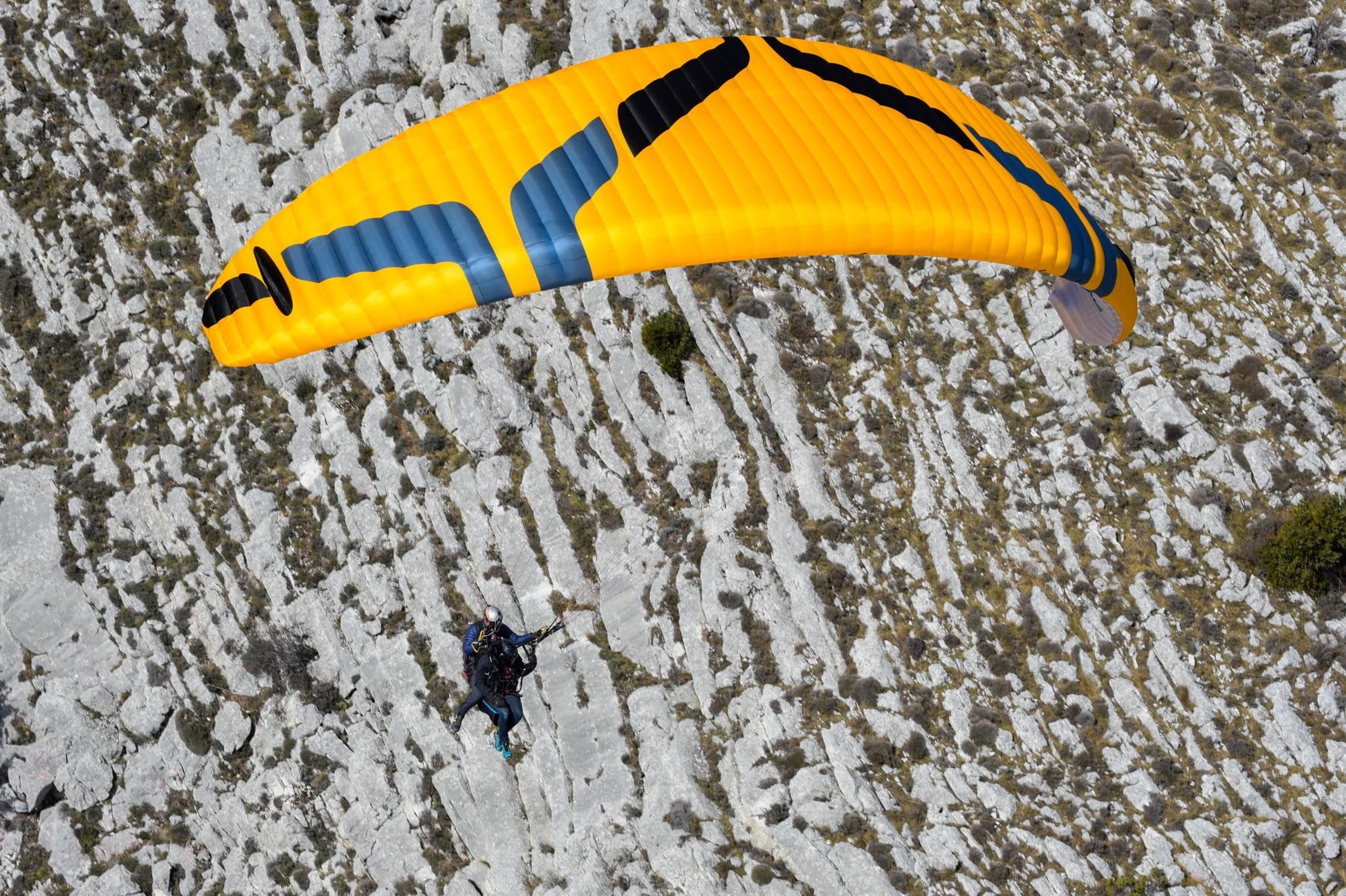
Ozone paragliding wing in flight above the relief of the Alpes-Maritimes
Frequently asked questions

Your questions about paragliding equipment

Composition, budget, purchase, maintenance: the most useful answers before equipping yourself.

What does a paraglider's complete equipment consist of?

Four basic elements: the wing (the sail), the harness (with the back protector), the Helmet certified to EN 966 standard and the emergency parachute. Instruments (variometer, GPS, radio) and accessories are added. For a tandem flight, the school provides all the equipment.

What budget should I plan for paragliding equipment?

In mint condition, count €4,000 to €6,000 for a complete kit: around €3,000 to €4,500 for the wing, €700 to €1,500 for the harness, €100 to €400 for the helmet, €500 to €900 for the reserve, €200 to €1,000 for instruments. Second-hand gear, checked by a professional, significantly reduces this budget.

Should you buy your own equipment to start paragliding?

No. In initiation, the school provides all the equipment. You invest in your own gear once you've learned the basics, on the advice of your instructor: an EN A wing suited to your weight and a harness suited to your build.

Which paraglider wing should you choose when you are a beginner?

A type-approved wing EN A, the most forgiving, sized according to your total in-flight weight. You then progress to an EN B for better performance. The choice is always made with an instructor: a wing that is too high-performance for one's level is a real risk factor.

Where to buy and service paragliding equipment?

From a specialist dealer and an authorised workshop for Revision. At Gréolières, Ailéments relies on its partner workshop, Aerotech (Ozone sales and servicing). A wing is serviced approximately every 100 hours or every two years.

Do you need to bring any equipment for a paragliding tandem flight?

No, nothing to bring. For a Tandem paragliding, the school provides and pays for everything: checked wing, passenger harness, EN 966 certified helmet. Just bring warm clothes and closed-toe shoes. The equipment only becomes your purchase during training towards autonomy.

Written by the team Ailéments — paragliding instructors & canyoning

Paragliding school based in Gréolières (06) since 2013, Ozone dealer and workshop. Our state-qualified instructors (DEJEPS) equip passengers and advise pilots every day: equipment selection, tuning and maintenance are all part of our job.

DEJEPS Tutors Since 2013 FFVL Affiliates +1070 5/5 reviews
The essentials

Paragliding equipment: key points

Four benchmarks for choosing the right equipment without mistakes, from your first flight to independence.

1

A system, not a list of items

Family, harness, Helmet and safety measures are chosen together, in accordance with your level and your experience.

2

We'll start with the school equipment

Nothing to buy to start with. We invest gradually, advised by an instructor, aiming for a wing EN A to begin with.

3

A budget to spread out

A complete new kit goes for around €4,000 to €6,000. Opportunity helps, but only with a pro's opinion on the actual condition.

4

Tracked equipment flies safer

Revision Regular wing checks, annual reserve parachute repack, dry storage. Used for tandem flights, Ailéments supplies and takes care of everything.

Fancy a flight before investing?

Checked wing, comfortable harness, certified helmet and state-certified instructor: for a tandem flight on the French Riviera, you don't need to bring a thing. We take care of all the equipment, you just enjoy the flight.

Book my paragliding baptism