


To form
In school, supervised
We don't learn alone: we begins in school with a monitor, and you don't fly autonomously until the patent He did not validate it. Even if it is confirmed, it is better to avoid flying completely isolated.
Flying safely is not about checking off a list of rules: it's about having the right approved and revised equipment, choosing the right conditions, and above all, having the right feeling—the feeling that comes from practice. The Paragliding Safety Guide has been available from our DEJEPS instructors Gréolières since 2013.
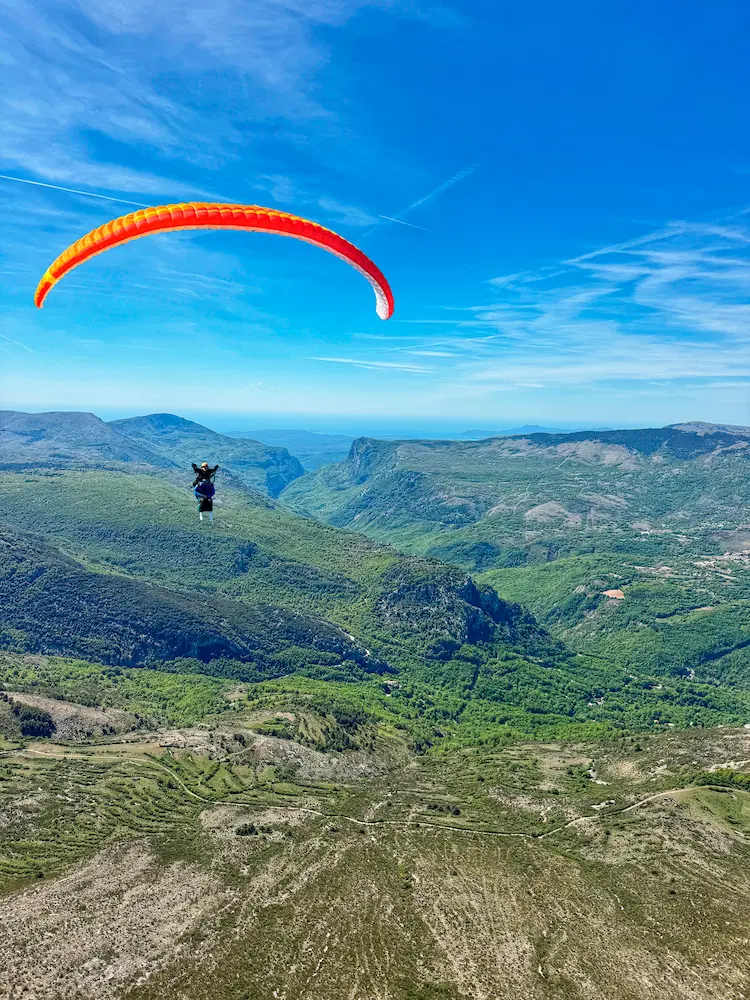 Flying calmly, flying safely
Paragliding safety is not just a set of instructions on a poster. The rules are essential—they lay the foundation—but they alone do not make a safe pilot. What makes the difference is everything that is built around it: the right equipment, the right judgment, and the feeling.
Paragliding is a sport that is taken very seriously. One flies in it with all the more safety if one has practiced a lot: the body eventually acts because it feels it, even before it thinks about it. This parapant safety guide addresses the three pillars — the rulesthe Approved and revised equipment, and the feeling — without any pretense.
It is written by the Ailéments team, paragliding school at Gréolières (06) since 2013. Our state-certified instructors (DEJEPS) transmit safety every day, from the first inflation to autonomous flight: for us, it is first and foremost a culture, not a requirement.

These are the non-negotiables: they do not guarantee everything, but without them, nothing holds together. We apply them from the very first day and throughout our entire lives as pilots.
We don't learn alone: we begins in school with a monitor, and you don't fly autonomously until the patent He did not validate it. Even if it is confirmed, it is better to avoid flying completely isolated.
Flying in planes conditions suited to their level, and to eliminate any doubt. Most incidents are due to poorly assessed weather, not to bad luck. Read more'aerology is a security competency.
Keep some margin (altitude, speed, distance to relief and others), make a Complete check before each takeoff, Respect the airspace, and wear protective gear in good condition: helmet, back protector, emergency parachute.
Safety comes down to equipment, but not in any way that's not appropriate: it must be approved, of the appropriate standard, and maintained. A wing in good condition will forgive; a wing that's worn out or too demanding, not so much.
Family, harness and Helmet approved (EN/LTF standards), and especially adapted to his experience : A too sharp sail is a danger, not a shortcut. The right one equipment is the one that corresponds to your level.
Le Emergency parachute is the last barrier: it must be present, adapted to the weight, and reverted regularly to open quickly on the day you need to. You don't fly without one, and you never neglect folding it.
A sail ages and loses its safety: this is why it is important to have a regular review. Monitor the life span and to check the porosity is to steal from a secure material. Our workshop Aerotech, at Gréolières, takes care of that.
A well-controlled wing is a safe wing. In the air, you don't suffer: you anticipate, you balance, you keep the wing above yourself.
Keeping the wing pressurized, damping the pitching and rolling, anticipating the movements of the air: the active steering It warns of closures. It is this competence that transforms a situation of turbulence into one that can be managed.
Even when well managed, an incident can occur. Having already experienced a closure or a disengagement under safe and supervised conditions changes everything: that is the very purpose of Stage SIV, Above the water, which instills good reflexes.
That's the pillar that the lists of rules forget, and yet it's the most important one. You don't fly only with your head: you fly with your body, and the body reacts because it feel.
The good pilot does not calculate every move: he feels the wing in his hands and his seat, and corrects before he has had time to think. This feeling — what we call the feeling — it is not learned in any book. It is built up through repetition, until the wing becomes a natural extension of the body. It is he, after all, who holds the security in flight.
The best place to forge that feeling is the soil. Inflate, control the wing above your head, feel it react to the wind: every variation in pressure in the elevators teaches you something, without the risk of height. Dune of Pyla, With its sand and its regular wind, it is a temple of buoyancy. In our country, we deeply believe in this. daily work on the ground The more you play with the wing, the more natural — and sure — the gesture becomes.
Baptism or autonomy: safety is transmitted through monitors who fly every day and have made it second nature.
Visit first two-seater flight, It is the state-certified instructor who decides, pilots and ensures the safety of the entire flight. The safest way to experience the sky, without having to manage anything.
Visit internship, In order to build safety, we build on the following principles: inflation and handling on the ground, takeoff, active piloting, and reading the air. Each flight is guided via radio and debriefed to ensure the correct procedure is followed.
Between the sea and the mountains, our sites in the Alpes-Maritimes offer varied conditions for learning to fly safely, under supervision, and preventing rather than curing — the opposite of a simple list of rules. Prevention also means knowing the causes of the accident.
Since 2013 at Gréolières, the team Accessories transmits a culture of safety: clear rules, approved equipment, and revised on site with our workshop Aerotech, and especially the feeling which is acquired through the course of inflatations and flights. This feeling also fuels dynamic flight as well as the wing over.
State-certified instructors (DEJEPS), progressive pedagogy, safety first: over 1070 5/5 reviews It confirms it. The sky is worth it, and it is even more enjoyable when you are at peace there.
Learn with us
Rules, equipment, feeling, getting started: concrete answers.
To form a school and not fly alone at first, flying in groups adapted conditions, Keep a margin of safety, perform a complete check before each takeoff, respect airspace, and wear protective gear in good condition. Beyond the rules, safety is built through a sense of responsibility.
It is the feeling that allows the body to act before it even thinks about it. The pilot feels the wing in his hands and his seat, and reacts because he feels it. This feeling is acquired through practice — especially the work on the ground, the inflation — until the wing becomes an extension of the body. That's the heart of safety.
By practicing a lot, especially at soil. The inflatable allows you to feel the wing and to gauge your movements without the risk of heights — the Dune du Pyla is a well-known example. The more you inflate, the more natural the movement becomes. Our courses they make a large place for this work on the ground.
No. We always start in a school setting, under supervision, and we don't fly alone until we're at least 16 years old. patent has not validated the autonomy. The first two-seater flight, He, in turn, is entirely under the responsibility of the instructor.
Practiced with good foundations, it is a controlled activity. The risk is reduced by approved and revised equipment, chosen conditions, and the experience gained through practice. Most of the incidents They come from an overconfidence or an underestimated weather, not from bad luck.
Four guidelines for flying calmly.
Training as a pilot, flying under your own conditions, keeping a margin of safety, checking before each flight. Indispensable, but not enough on their own.
At its level, by its standards, with recent assistance, and controlled regularly. A tired wing forgives less.
The body acts because it feels. This feeling is acquired through practice, especially the lifting off the ground, until the wing becomes an extension of oneself.
Paragliding is a game that requires repetition. The more you fly and inflate, supervised, the more natural the movement becomes — and safety is a given.
Clear rules, safe equipment and the feeling that comes with hours of practice: at Ailéments, we pass on all of that, from baptism to autonomous flight. The best time to start is now.
Discover our courses