Technique · Paragliding

Paragliding cross-country XC flying, from the first flight to Grand Cross

Prerequisites, thermals, transitions, flight planning and safety: everything you need to get started in cross-country paragliding, the art of taking off from your launch site to cover kilometres. A guide from our DEJEPS-qualified instructors, at Gréolières since 2013.

  • Prerequisites explained
  • Heating & transitions
  • Advice from DEJEPS instructors
  • +1070 reviews ★★★★★
View from a paraglider on a cross-country flight above the relief of the Alpes-Maritimes, panoramic view all the way to the sea Cross-country flight · Alpes-Maritimes
  • What is itFly far from takeoff
  • PrerequisitesGCSE · ~50 hrs · petrol
  • The engineThermal & dynamics
  • DistancesFrom 5 km to +100 km
  • ProgressionBoxed, step-by-step

Flying is already magical. Flying far is another adventure: leaving your take-off site, linking up thermals and covering kilometres at the mercy of the air. That is paragliding cross-country — distance flying, also known as cross-country.

This guide is aimed at the independent pilot who wants to take the plunge: what needs to be mastered before setting off, how to exploit thermals and transitions, how to prepare a flight plan, and how to stay safe far from your home airfield. The objective is not to replace a training course, but to understand the approach and progress in the right order.

It is written by the Ailéments team, paragliding school at Gréolières (06) since 2013. Our state-certified instructors (DEJEPS) fly daily at one of the most bountiful mountain flying sites on the Côte d'Azur: cross-country flying is genuinely practised and taught here.

Paragliding flight over the Alpes-Maritimes coast during a cross-country flight, with the sea and coastline below
The definition

What is cross-country paragliding?

The principle is simple to state, demanding to achieve: stay in the air as long as possible to go as far as possible, with no engine other than the rising air.

The principle

Assemble, transit, start again

In cyclo-cross, you get into a lift (thermal or dynamic), then we transit in a straight line, losing altitude, towards the next lift source — another slope in the sun, a cloud, a ridge. This «pump / transition» cycle is repeated to make headway. The whole art of cross-country flying lies right there: setting off with enough height, arriving high enough to hook back in.

Plain or mountain

Several forms of cross

Le cross country running hopping from thermal to thermal above gentle terrain; the fell running skirt the sun-drenched faces and play with the contours. Distances range from a few kilometres for a return ridge flight for a first cross-country, to over 100 km — or even multi-day raids — for top-level pilots, as in the legendary X-Alps.

Before getting started

The prerequisites for starting cross-country running

The cross-country is not just another stage, it is a milestone. You don't just dive into it straight out of the training It requires genuine autonomy and solid reflexes, because you are flying in sustained air and far from your home airfield.

Autonomy

Licence and flight hours

You need to be an autonomous driver: Pilot's licence validated and, in practice, at least one around fifty flight hours. The figure matters less than actual fluency: knowing how to take off anywhere, managing your landing, not being overwhelmed by the air. Cross-country flying is built on safe foundations.

Mastery

Active and thermal flying

Cross-country paragliding takes place in thermals, meaning in turbulent air. A active steering solid and the ease to wrap a thermal are essential. You need to know how to keep the wing under pressure, manage a surge, and fly flat in a tight thermal without losing it.

Safety

An SIV course before it gets too strong

Before tackling the hard part of the cross-country, a Stage SIV (flight incident simulation, over water and supervised) is strongly recommended: it teaches you how to handle collapses and incidents with a cool head. It is the cross-country pilot's life insurance.

The heart of the cross

Thermals, transitions and flight plan

Cross-country paragliding is about making a sequence of decisions: where to climb, when to leave, in which direction. Three skill sets combine to progress efficiently and safely.

Go up

Locate and centre thermals

It all begins with reading the air: identifying the thermal trips (sunny slopes, rocks, cumulus clouds), entering them cleanly then centre the thermal for climbing as quickly as possible. The variometer guides you, but it is your feel that refines it.

Move forward

Make the transition at the right time

We are leaving a thermal top to transition to the next one, managing one's speed according to the wind: faster into the headwind, more economically downwind. Setting off too low risks having to land out; setting off too late means wasting time. The right balance is worked on flight after flight.

Decide

Prepare a flight plan

A good cross-country flight is planned before take-off: wind direction, logical route along the ridges, trigger points, emergency landings spotted all the way along the route. We adapt on the fly, but we never set off without having a mental image of the journey and its escape routes.

Fly far, fly safe

Weather and safety in paragliding

Far from home and in strong lift, the safety margin is prepared on the ground and preserved in flight. Cross-country flying rewards cautious pilots, not the rushed.

The weather window

Choosing your day

Cross-country flying requires active yet manageable conditions: good thermals without being excessive, a moderate high-altitude wind (above 25-30 km/h at altitude, we give up). The analysis of flight conditions and paragliding weather tools is a non-negotiable prerequisite.

Litter everywhere

To play possum«

In cross-country paragliding, you often land away from marked airfields: this is known as «landing out». You need to know select a field (slope, wind, obstacles, access), successfully complete an unfamiliar approach and respect the site and landowners. An early precautionary landing is never a failure, it is a good decision.

The margin

To keep something in reserve

The golden rule: never gamble with your safety for the sake of a few kilometres. You keep a safe height above the terrain, you turn back if doubt sets in, you do not fly a wing beyond your capabilities. The best cross-country pilot is not the fastest, it is the one who always goes in.

The equipment

Equipment suitable for cross-country

You don't change your equipment for cross-country flying; you adapt it to your discipline and level. Comfort, aerodynamics and instruments make all the difference on long flights.

Harness & wing

A wing to suit their level, a pod harness

For cross-country, a wing EN B (or in C for the experienced) offers a good performance-security compromise — never outclassed. On the comfort side, the pod harness, sleek and aerodynamic, reigns supreme on long-haul flights. The choice is made with a monitor, as our hardware guide.

The instruments

Vario-GPS and navigation

A GPS vario quickly becomes essential: it announces thermals, records the track, and displays ground speed and wind. To plan and analyse their flights, pilots rely on dedicated applications (XContest, Syride, FlyXC) and on Google Earth or ICAO charts, in order to visualise the route and the airspaces to be respected. Many add a radio and a tracking device. Debriefing your flight path afterwards remains one of the best tools for progression.

With Ailéments

Cross and Ailéments: our role, our advice

Let’s be clear about our role: at Ailéments, we work on the thermal flight for intermediate levels, adapted to your level — the very foundation of motocross. On the other hand, we do not offer cross-country flying course Strictly speaking: to this end, we’ll be happy to refer you to the specialist school that’s right for you.

Discover

Experience cross-country tandem paragliding

Not independent yet? A long tandem flight Flying with an instructor allows you to experience the thermals and sweeping landscapes of cross-country flying in complete safety — the best way to find out if cross-country flying is for you.

Working on thermal performance

The basics of cross-country running, tailored to your level

From initiation to patent then into Further training, our courses are working on the active steering and the thermal flight — which is tailored to each rider. This is the essential foundation before considering the distance.

Our advice

We’ll guide you according to your level

«Cross course» says it all — from an introduction to thermal flying to a proper cross-country course. For the Distance flight If you’re serious about it, a specialist school is best: for experienced pilots (BPC level), the Aerogliss XC Master course, in the Southern Alps, is a fine example. Get in touch with us we recommend the package suited to your level.

The Ailéments School

Our role extends to self-reliance — our advice goes even further

Since 2013 at Gréolières, the team Accessories trains pilots up to licence level and works on thermal flight advanced training, tailored to each level. The cross-country flying course, however, we do not offer this service: we know the best specialist schools and are happy to advise you.

Do you have a question about your progress or choosing a cross-country training camp? Please don’t hesitate to get in touch — we’ll be happy to advise you based on your level.

Contact us
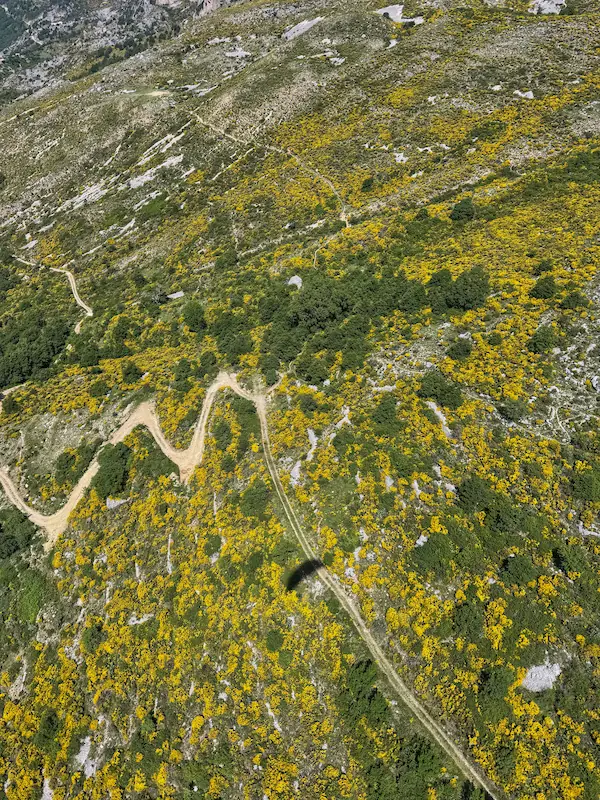
The shadow of a paraglider cast upon the hillsides covered in flowering broom whilst flying a cross-country flight
Frequently asked questions

Your questions about paragliding cross-country flights

Definition, prerequisites, equipment, safety, progression: practical answers.

What is cross-country paragliding?

Cross-country flying is the art of flying far from your take-off point to cover several kilometres by linking thermals together. One go up in a thermal, you transit on to the next thermal, and repeat. A cross-country flight can range from a few kilometres along a ridge to over 100 km for experienced pilots.

What are the prerequisites for taking up cross-country running?

Being an autonomous pilot: Pilot's licence, active steering sound, thermal proficiency, stress management. At least fifty hours of flight time is recommended and a Stage SIV before tackling the strong air of the cross.

How many flight hours before doing cross-country?

No regulatory threshold, but one is commonly recommended around fifty hours after the brevet. What matters is real proficiency: centring a thermal, managing a collapse, landing out. A first cross-country flight should be approached with supervision, over short distances, at a familiar site.

What equipment is needed for cross-country paragliding?

A wing suited to their level (often EN B for beginners, EN C for experienced pilots), a pod harness aerodynamics, and a GPS vario. Never fly a glider above your class: safety comes before glide performance. hardware guide sets out the options.

Is cyclo-cross dangerous?

It is practised in sustained air and away from your home site, so it is more demanding. Risks are managed through progression: active piloting, SIV courses, conditions suited to your level, a safety margin and identified emergency landing sites. You progress in stages, under supervision. A good decision on the ground is better than a forced flight.

How to start cross-country paragliding?

By strengthening its autonomy (patent, active steering, thermal), then by starting with short cross-country flights at a familiar site. At Ailéments, we practise thermal flight for progression, adapted to your level; for the pure cross-country flying course, we direct you towards a specialised school. Flying in a group and debriefing your GPS tracks speeds up progress enormously.

Written by the team Ailéments — paragliding instructors & canyoning

Paragliding school based in Gréolières (06) since 2013. Our state-qualified instructors (DEJEPS) fly daily over the relief of the Alpes-Maritimes, a renowned cross-country flying terrain: guiding pilots towards their first cross-country flights is part of our profession.

DEJEPS Tutors Since 2013 FFVL Affiliates +1070 5/5 reviews
The essentials

Paragliding cross-country: key takeaways

Four benchmarks for tackling cross-country flying in the right order.

1

Assemble, transit, start again

The cross connects origins and transitions to make progress. Starting high, reaching high enough to hook it: that’s what the whole game’s about.

2

Autonomy first

GCSE, ~50 hours flight time, active steering and thermal control, SIV training: you shouldn’t attempt cross-country flying without these basics.

3

Safety before distance

Reasonable high-altitude wind, emergency landings identified, knowing how to «make the cow» [land out], keeping a reserve. The good cross-country pilot is one who always goes in.

4

Thermal first, distance second

Ailéments is working on the thermal flight for advanced training, adapted to your level. For the cross-country flying course, you are advice the good specialist school.

Fancy seeing further afield?

Whether you’re dreaming of flying your first few kilometres or simply want to experience the stunning scenery of a tandem cross-country flight, it all starts with a flight. To fly on the Côte d’Azur, all you need to do is book.

Book my paragliding flight